
What’s in this guide
- Why PDF Files Get So Large in the First Place
- What Actually Happens When You Compress a PDF
- How to Compress a PDF Online: Step by Step
- Choosing the Right Compression Level
- Will Compressing Actually Reduce Quality?
- When You’ll Actually Need to Compress a PDF
- Compressing vs. Other Ways to Reduce File Size
- A Few Practical Tips Before You Compress
- Frequently Asked Questions
- The Bottom Line
If you have ever tried to email a PDF and gotten an error about attachment size, or watched a “file too large” message pop up while uploading a document to a job portal, you already know the problem this guide solves. PDF files — especially ones full of scanned pages or high-resolution images — can balloon to tens of megabytes without you doing anything wrong. The good news is that shrinking them back down rarely requires any special skill, and in most cases it does not noticeably hurt how the document looks.
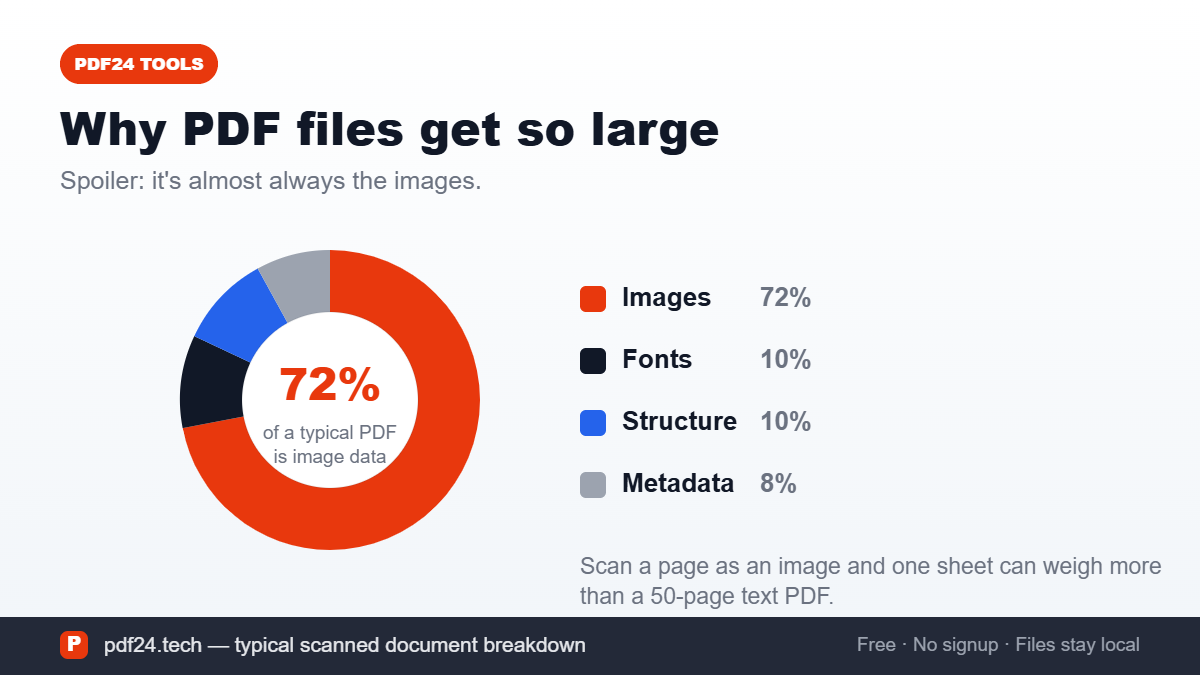
This guide walks through why PDFs get so large in the first place, what actually happens when a PDF is compressed, how to do it in a few clicks, and how to pick a compression level that keeps your document readable.
Why PDF Files Get So Large in the First Place
A PDF is really a container — it can hold text, fonts, vector graphics, and embedded images all in one file. Most of the time, when a PDF feels unreasonably heavy, one of a few things is going on:
- Scanned pages are stored as images. A scanner doesn’t save “text” — it saves a photograph of the page. A ten-page scanned contract can easily be five to ten times larger than the same ten pages typed directly into a word processor.
- Images are embedded at print resolution. A photo that looks fine on screen at 150 DPI might be embedded at 300 DPI or higher because that’s how it came out of the camera or design software, even though nobody is going to print the PDF.
- Fonts are fully embedded. To make sure a document looks identical on every device, PDF software often embeds the complete font file rather than just the characters actually used.
- The file has been edited many times. Every round of edits in some PDF editors can leave behind old, unused data that never gets cleaned up automatically.
None of this is a mistake on your part — it’s simply how most PDF-creation tools default to preserving maximum quality, whether or not you actually need it.
What Actually Happens When You Compress a PDF
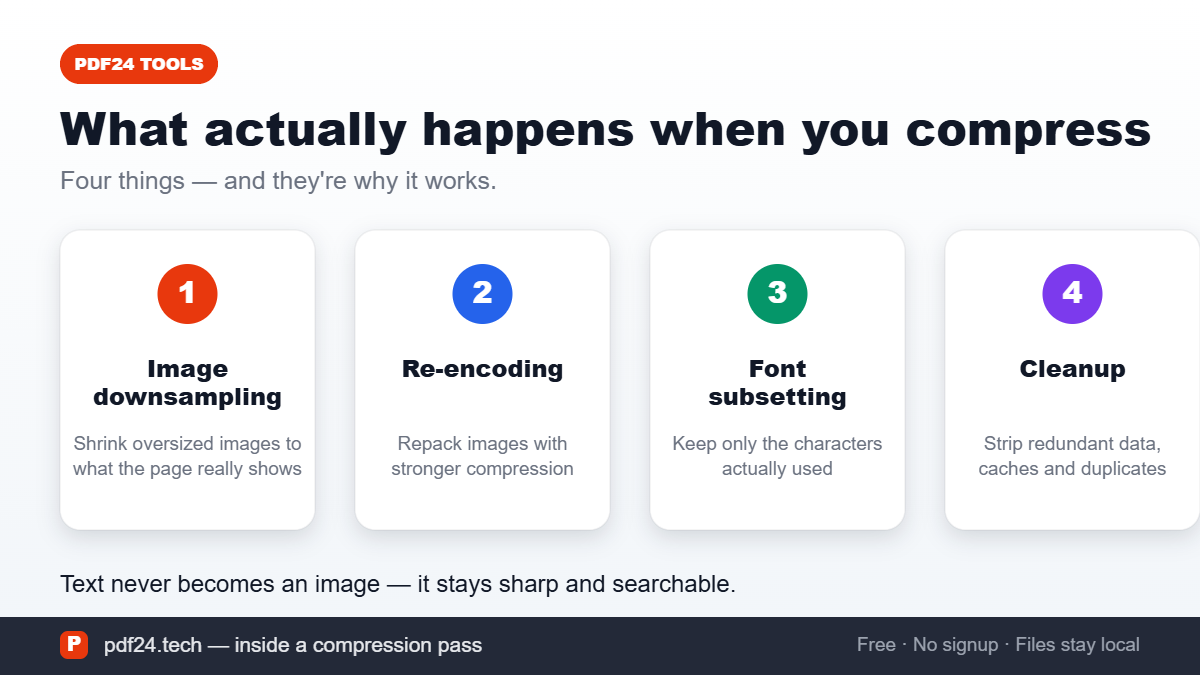
“Compression” sounds like one action, but it is really a bundle of smaller optimizations working together:
1. Image downsampling
This is usually where the biggest size savings come from. An embedded photo at 300 DPI gets resampled down to something like 150 or 96 DPI — still sharp on a screen, just not overkill for print.
2. Re-encoding images with stronger compression
Beyond resolution, the image data itself can be re-encoded more efficiently, similar to how a JPEG at 60% quality looks nearly identical to one at 95% quality but takes up a fraction of the space.
3. Font subsetting
Instead of embedding an entire typeface, the PDF keeps only the specific characters actually used in the document.
4. Removing redundant data
Leftover metadata, duplicate objects, and unused elements accumulated from earlier edits get stripped out.
Text itself is rarely the problem — plain text compresses extremely well on its own and is almost never the reason a PDF is large. That’s why a 40-page text-only report might already be under a megabyte, while a 4-page PDF with two high-resolution photos can be five times bigger.
How to Compress a PDF Online: Step by Step
You don’t need Adobe Acrobat or any other paid software to shrink a PDF. Using the free Compress PDF tool, the process looks like this:
- Open the Compress PDF tool and drop your file into the upload area, or select it from your device.
- Choose a compression level — light, medium, or strong, depending on how small you need the result and how much you care about squeezing out every extra kilobyte.
- Start the compression. For most documents this takes only a few seconds.
- Download the compressed file and do a quick check — open it and glance at a couple of pages, especially any with photos or fine print, before you delete the original.
That’s the entire process. There’s no account to create, no watermark added to your file, and no limit on how many times you can use the tool.
Choosing the Right Compression Level
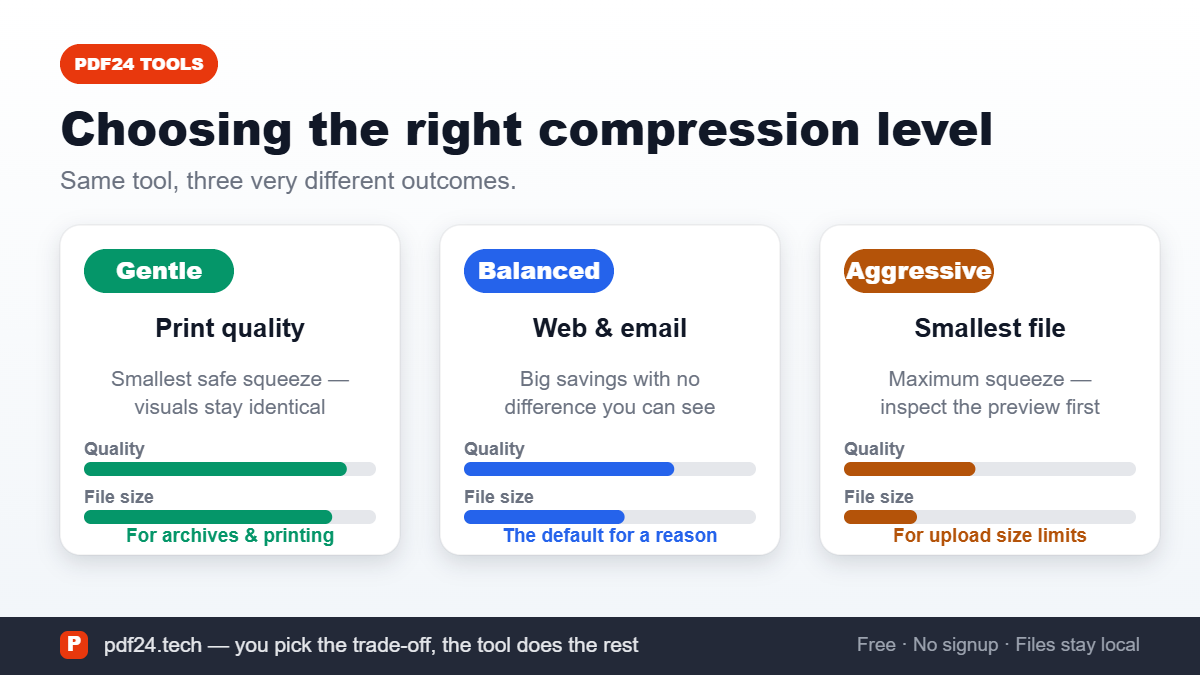
Most compression tools, this one included, offer a few preset strength levels rather than dozens of granular sliders. Here’s a practical way to think about which one to pick:
Light compression is the safest choice when the PDF contains design work, product photography, or anything where fine visual detail matters — think a portfolio or a printed brochure. You’ll get a modest size reduction with essentially no visible difference.
Medium compression is the right default for most everyday documents: reports, invoices, presentations exported to PDF, and scanned paperwork that just needs to be email-friendly. This is where most people land.
Strong compression makes sense when file size is the priority and the content is mostly text or simple graphics — think internal memos, contracts, or anything where nobody is going to zoom in on an image. This setting sacrifices the most image quality in exchange for the smallest possible file.
If you’re not sure which to pick, start with medium. You can always try strong afterward and compare the two results before deciding which one to send.
Will Compressing Actually Reduce Quality?
This is the question almost everyone has, and the honest answer is: it depends on what’s in the PDF and how hard you compress it.
Text stays text — headings, paragraphs, and body copy remain exactly as sharp after compression as before, because text in a PDF isn’t stored as a picture (unless the whole page came from a scanner). What changes is the images. At light or medium settings, the difference is usually invisible unless you zoom in significantly. At strong settings, you may start to notice softer detail in photos, particularly ones with fine texture or gradients.
A useful habit: keep the original file until you’ve confirmed the compressed version looks acceptable for your purpose. If you’re sending a scanned legal document, it’s worth opening the compressed file and checking that signatures and small print are still legible before you send it anywhere.
When You’ll Actually Need to Compress a PDF
A few everyday situations where this comes up constantly:
Email attachment limits. Most providers cap attachments around 20–25MB, and a lot of scanned documents or design files blow past that easily.
Job and university application portals. It’s common for these systems to cap uploads at 2–5MB per file, which a resume with an embedded photo or a scanned transcript can exceed surprisingly fast.
Website uploads. If you’re adding downloadable PDFs to a website, smaller files mean faster load times for visitors — and page speed genuinely affects both user experience and search rankings.
Storage and backups. If you’re archiving years of scanned paperwork, compressing each file adds up to real savings in cloud storage space over time.
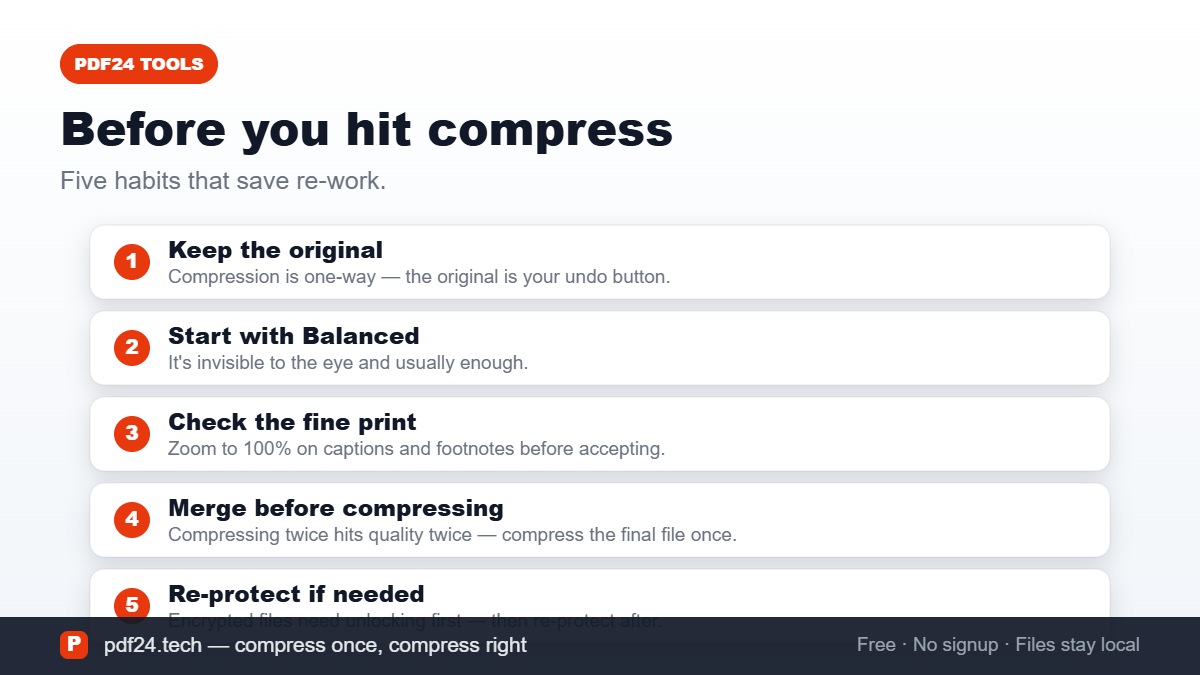
Compressing vs. Other Ways to Reduce File Size
Compression isn’t the only lever available, and sometimes it’s not even the right one. If a PDF is large because it has far more pages than you actually need to send, using Split PDF to pull out just the relevant pages might solve the problem more directly than compressing the whole thing. On the flip side, if you’re assembling several smaller files into one — say, combining a cover letter with a resume — Merge PDF is the tool for that, and you can compress the combined result afterward if it’s still too large. Our full guide to merging PDFs covers how to get the page order right the first time.
If your PDF also needs a password removed before you can work with it at all, start with Unlock PDF first — most compression tools, including this one, can’t process a locked file until the password protection is removed.
A Few Practical Tips Before You Compress
- Always keep the original. Compression is generally one-directional — you can’t get back detail that’s been discarded, so don’t overwrite your only copy.
- Check scanned documents at a slightly higher zoom. Fine print, signatures, and small stamps are the first things to soften under aggressive compression.
- Compress after combining, not before. If you’re going to merge several PDFs into one, do that first, then compress the final result — it’s one less step than compressing every individual file.
- Re-check file size limits on the destination. A portal that says “5MB max” usually means it — a file at 5.1MB will still get rejected.
Frequently Asked Questions
Does compressing a PDF remove any pages or content?
No. Compression changes how the existing content is stored — it doesn’t add or remove pages, text, or images. Everything that was in the original document is still there.
Can I compress a PDF that’s already been compressed once?
Yes, though the size savings the second time around will usually be much smaller, since most of the easy reductions were already made.
Is it safe to compress sensitive or confidential documents online?
With browser-based tools, your file is processed on your own device rather than uploaded to a remote server, which is worth checking for any tool you use if privacy matters for that particular document.
Why is my scanned PDF still large even after compressing?
Scanned pages are images through and through, so there’s a practical floor to how small they can get without becoming visibly blurry. If a scanned file is still too large after compression, splitting it into smaller sections may be the more effective option.
The Bottom Line
Shrinking a PDF down to a manageable size is usually a two-minute task, not a technical project. Start with the free Compress PDF tool, pick medium compression as your default, and adjust up or down depending on what you see when you check the result. Between compressing, splitting, and merging, most of the “my file is too big” problems people run into with PDFs have a straightforward fix — no software installation or paid subscription required.